Corriente de fondo
Light installation, 2026, Museo Fundación Andreani,
Buenos Aires
![]()
![]()
![]()
![]()
![]()
![]()
![]()
![]()
![]()
![]()
![]()
![]()
![]()
![]()
![]()
Light installation, 2026, Museo Fundación Andreani,
Buenos Aires


“Corriente de fondo” is a site-specific light installation that works with the subtlety of light's color changes, blurring the perception of time and space to generate an experience of being in the light. The work connects the sensory and the emotional by constructing an environment of affective resonance.
Light, like sound, is a temporal phenomenon. Its constant transformation creates immersive atmospheres that affect our perception in subtle yet profound ways. While the sun emits all wavelengths of the visible spectrum, the waves we perceive as "red" are the first to reach our eyes when the sun is farthest away, at sunset or sunrise. What is the relationship between this scientific fact and the emotional, sensitive, and poetic implications of light color? This installation brings forth that deep core, that current that shapes the structure of a fluid, changing, almost imperceptible sensation, like the changing colors of the sky. The installation materializes by intervening in the glass brick floor of the third floor of the Andreani Foundation, taking advantage of its architecture. Light gradients inspired by the colors of the sky during sunrise and sunset were used: warm, enveloping tones in a 12-minute looped spatio-temporal animation. The red of the furniture, the railing, and the lights of the exterior terrace are integrated as active elements, enhancing the immersive experience of the space. The matrix of glass bricks functions as a pathway that invites connection with the view from the window, a path that ends in a semicircle framing the sky. A horizon mediated by geometry. The brick matrix also functions as an organizing element, a failed attempt to separate, to cut and define the indefinable nature of those slow, imperceptible color changes.
The apparent movement of the sun and the color gradients in the sky are deeply rooted in our imagination. Although the sky is perceived as a static dome, it is actually a vast expanse of gases in constant transformation. If we think of light as the condition that makes vision possible, and the visual as light, we can feel that we are immersed in the light of the atmosphere.
VIDEO
Activar un paisaje
2026, Intervención video-lumínica en La Gran Lámpara, 20´ Palacio Libertad (ex CCK)
![]()
![]()
![]()
![]()
![]()
![]()
![]()
![]()
![]()


This intervention emerges as a satellite to the work “Hacer un paisaje” (Making a Landscape), continuing to explore the building's void and circulation spaces as a naturalized artificial landscape. It represents a humanized nature; through its staircase and large light fixture, it connects us to a sense of vastness—an orthogonal planet, a chromatic utopia. With slow movements and transitions, and a harmonious color palette, the volume shifts gradually from red to blue, passing through various intermediate gradients inspired by the colors of the sky as the atmosphere slowly cools and warms. It is an installation that invites exploration, akin to ascending a mountain viewpoint to gaze upon a glacier. Details reveal themselves from different floors—viewed from both near and far—as reflections and nuances emerge through the interplay of forms. It is a planet; it is alive, like a massive, natural force. The aim is to evoke the feeling of a journey through a distant galaxy.
VIDEO
Hacer un Paisaje
Light installation, 2026, Centro Cultural Ex Correo Central, Buenos Aires
![]()
![]()
![]()
Light installation, 2026, Centro Cultural Ex Correo Central, Buenos Aires


This installation is composed of poetic objects that process light. It addresses the phenomenon of light and its effects on a particular material, both through its physical qualities and its sensory effects. Through specific scientific knowledge about light and its relationship with other materials, it seeks to reveal its emotional power. It connects the beauty of light and its relationship with the universe.
There is a link with the building: it is embedded, amalgamated, fitted, and reflected.
White mirror. Diffuse and sharp at the same time. It changes slowly. It elevates the function of the space it occupies. Residual space, a passageway, unnoticed.
It problematizes the idea of landscape. Due to its dimensions, the building shapes the landscape and allows for a distant view of the intervention. But it also creates an immersive in-space; it can be inhabited. It haptically affects bodies, modifying, through this bodily interruption, the distant view and the forms of that landscape.
The light sculptures that comprise it were created from the idea of electronic flora. They are sustained like symbiotic devices, suspended from the building's architecture, focusing on a detail of its construction and revealing the beauty of the conjunction between macrocosm and material microcosm. The grafted objects, supported, almost floating in tension, are discreet objects, but their effects are continuous. Slowness, deceleration, and contemplation; encounters, intersections, and ensembles emerge from the distance between natural and artificial light.
VIDEO
ph: Luna Chapur
Rojo Fulgor
Site specific Light installation, 2025, Santiago de Chile
![]()
![]()
![]()
![]()
![]()
![]()
Site specific Light installation, 2025, Santiago de Chile


The apparent movement of the sun and the color gradients in the sky are deeply ingrained in our imagination. Although the sky is perceived as a static dome, it is actually a vast expanse of constantly transforming gases. If we think of light as the condition that makes vision possible, and the visual as light, we can feel immersed in the light of the atmosphere.
Red Glow is a light installation that works with the subtlety of light's color changes, blurring the perception of time and space, and generating a kind of suspended state. It proposes an experience of being in the light, in which the sensory and the emotional intertwine. Through lighting devices integrated into the architecture, a poetic environment will be constructed that combines scientific research and affective resonance.
Light, like sound, is a temporal phenomenon. Its constant transformation allows for the creation of immersive atmospheres that affect our perception in a subtle yet profound way. While the sun emits all wavelengths of the visible spectrum, the waves we perceive as "red" are the first to reach our eyes when the sun is at its farthest point—at sunset or sunrise. What is the relationship between this scientific fact and the emotional, sensory, and poetic implications of that color?
I am interested in exploring that deep core, that invisible underwater current that shapes the structure of a fluid, ever-changing, almost imperceptible sensation, like the shifting colors of the sky.
Within this framework, the concept of chromosaturation, developed by Carlos Cruz-Diez, is also incorporated as a reference point for considering total immersion in color. Not as an end in itself, but as a tool to enhance the perception of color as an autonomous and living reality.
The installation was realized in the foyer on the second floor of the University of Chile Theater in Santiago, Chile. Taking advantage of its architecture—where artificial light highlights the morphology of the ceilings—the light wells of the space were transformed. The design incorporated light gradients inspired by the colors of the sky at sunset: warm, enveloping reddish tones and a 7-minute animation. The red of the carpet is integrated as an active element, enhancing the immersive experience.
fotos y video: Luis Bahamondes
video
Machines of Joy
Light installation, 2025, DEVCON Buenos Aires
![]()
![]()
![]()
![]()
![]()
![]()
![]()
Light installation, 2025, DEVCON Buenos Aires




“Artists do not create objects, but create by way of objects.” James P. Carse, Infinite Games
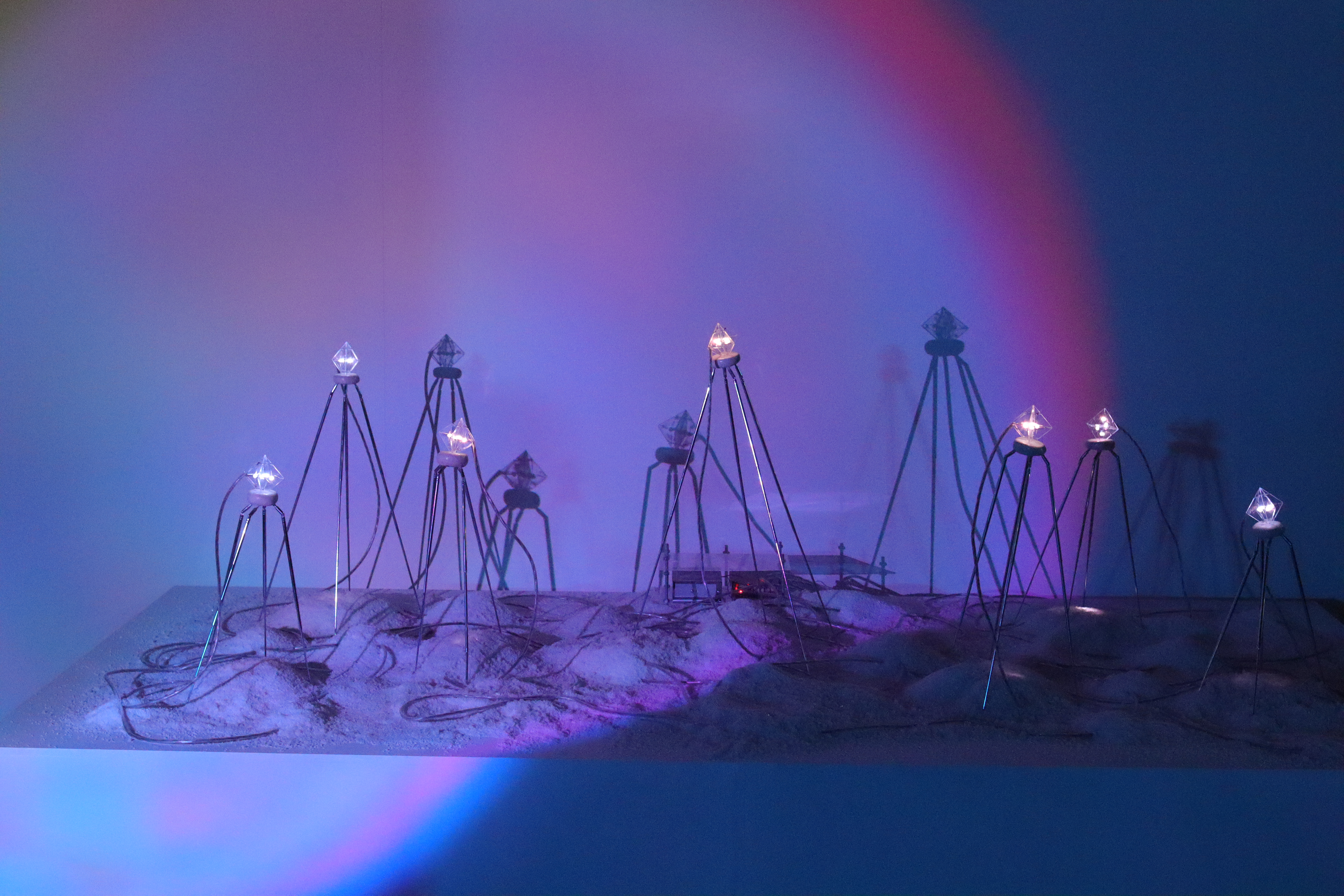
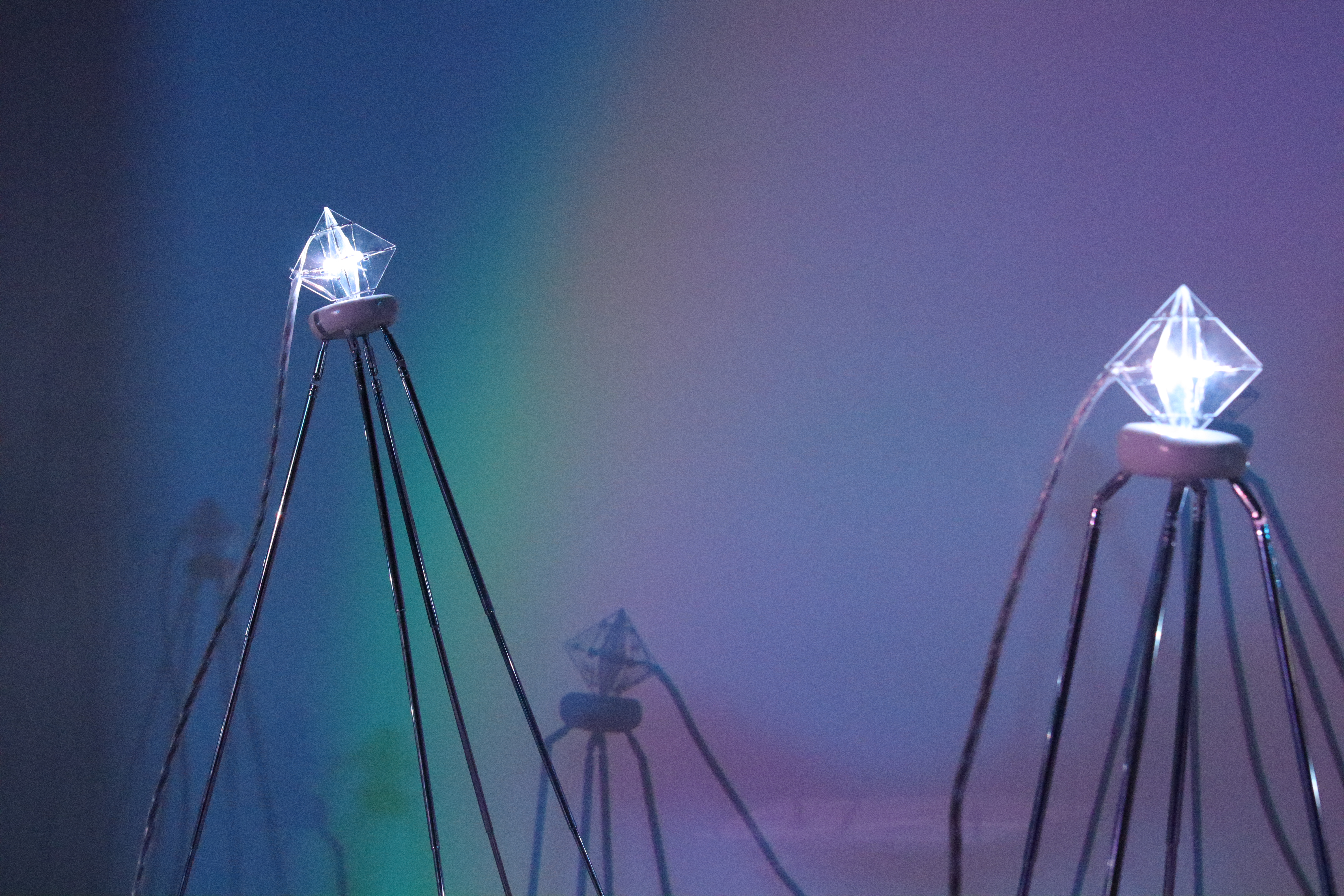
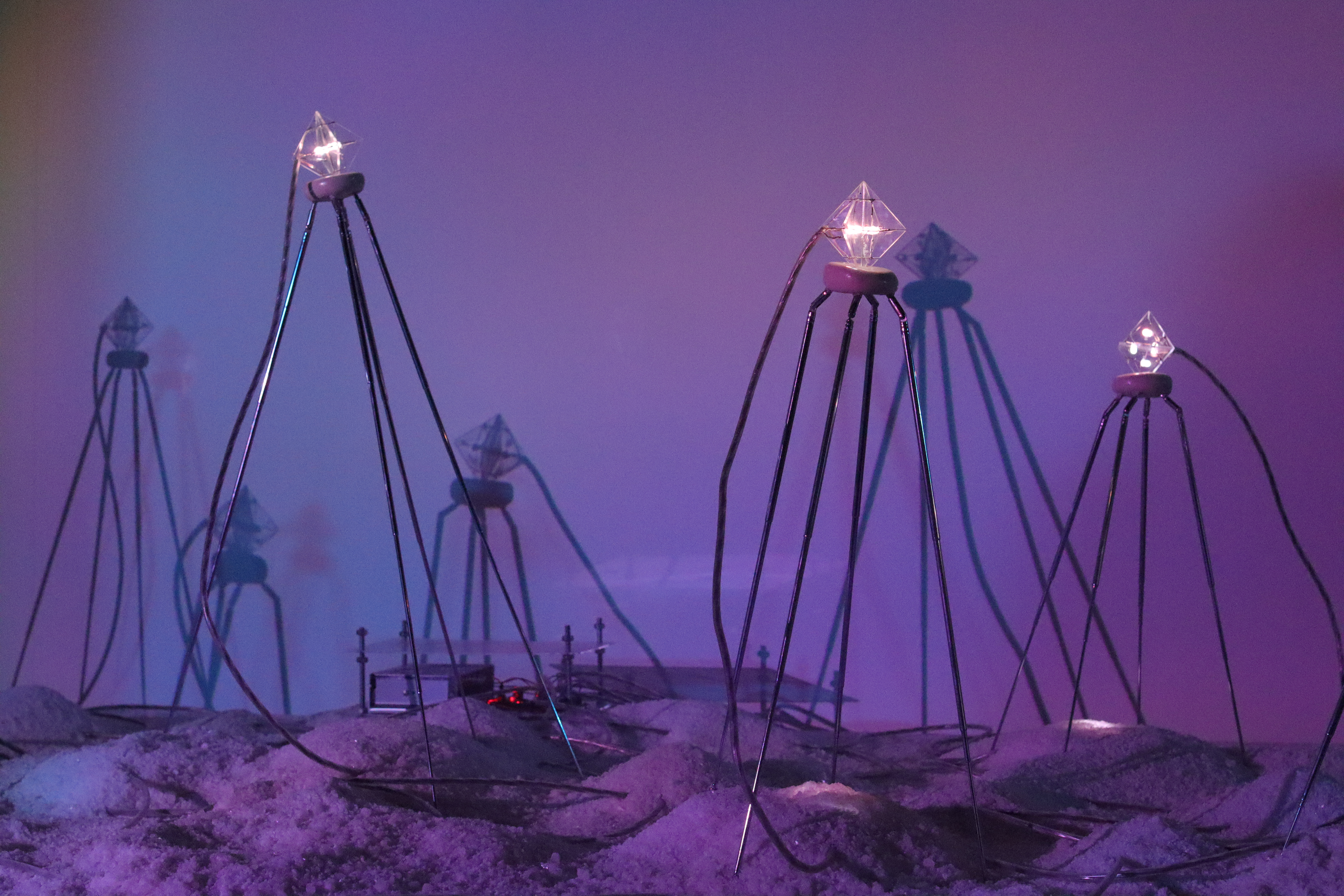
Machines of Joy is an electronic garden composed of light-emitting robots and electronic waste. Conceived as a small universe of its own, the installation constructs a system in which material, conceptual, and informational elements interact through circulating signals.
The title reflects the intention to create devices that, although built from discarded technology, emit light, color, and movement capable of evoking perceptual connection. These machines are not tools of utility but instruments of sensation, inviting viewers to engage with the interplay between artificial and natural elements. Through their motion and luminosity, they suggest forms of renewal, transforming electronic waste into sources of vitality and poetic experience.
The installation draws inspiration from the apparent movement of the sun around the Earth and the atmospheric colors it generates. Each robot reproduces gradients drawn from the sky and is designed to sense and respond to their surroundings in movements recalling the rhythms of planetary motion. The installation turns these natural phenomena into poetic objects, approaching light through both its physical qualities and its sensible effects, and drawing on knowledge about natural light to reveal its emotional resonance and its relationship with the universe.
It was presented in the group exhibition Echoing as one, which took place during the Ethereum International Conference in November 2025 in Buenos Aires.
ph: Tomo Saito & Delfina Levi